Showing posts with label Post-Collapse. Show all posts

Sunday, August 11, 2024

Producing Our First Audiobook Through ACX

Shadow Fusion LLC recently published its first Audible audiobook, Search for Haven by Justin Oldham, through audiobook distributor ACX. We had looked around at various companies, but ACX offered the right combination of advantages to meet our needs.

The first step in the process was to ensure that we had a Kindle e-book listed on Amazon.com that met the requirements for building as an audiobook.  Some of those requirements are

  • being “live” (released and actively for sale),
  • having Worldwide or United States distribution rights,
  • being in the English or Spanish language,
  • having cover art, and
  • being less than 240,000 words (approximately 26 hours).

All of the requirements, along with suggestions for resolving issues related to them, can be found in KDP's Help topics.

Once we verified that our book was eligible, we confirmed that we had the audio rights to the book we wanted to produce. Next, we confirmed that Search for Haven was an appropriate type of book to potentially do well in audio format.  Novels, short story compilations, biographies, histories, and similar prose works make better audiobooks than books like cookbooks, reference books, dictionaries, gardening guides, and picture books.  ACX provides a list of books that don’t usually make good audiobooks.

We signed up as a user in ACX.  To do this, we selected the “Get Started” button on the main ACX page.  New users can sign up for ACX using an existing Amazon account or by creating a new account using a different e-mail address.

We then set up our user profile.  We selected our name from the upper right corner of the screen, selected Account Settings, and entered the appropriate tax and payment information.  You can also change when you receive e-mail notifications from ACX and update your account information.

The next step was to claim the title we wanted to produce.  On the main screen, under our name, was a circled plus sign and the words “Claim your title”.  We selected that, then looked at the list of our titles that came up.  We found Search for Haven and selected the “Claim Title” button on the right.

We then created a Title Profile.  This is the information about the specific audiobook we wanted to produce, including the author name, a description of the book, how many words it has, what we were looking for in a narrator, and how we wanted to pay for our production.

There are three of options available to you for paying to produce an audiobook through ACX.  The first is a Pay-for-Production.  This is a flat rate of however many dollars you are willing to pay per hour of finished audio.  The second option is Royalty Share. This is where you and the producer (the person or group creating the narration of your audiobook) split the royalties paid by ACX.  You don’t pay a fee.  Instead, the narrator/producer receives their payment over time in the form of royalties.  The third option is Royalty Share Plus.  This is a combination of Pay-for-Production and Royalty Share.  You pay the producer an up-front fee and they receive a portion of the royalties.  This can allow you to access to producers that have higher rates for a smaller up-front fee.

Once we determined how we wanted to pay for the services of a narrator/producer, we were ready to move forward to find one.  To do that, we first needed to develop an audition script.  For our audition script, we chose a couple of short scenes from the book that we would ask the candidates to record.  Next, we selected “Receive auditions for my project to find a Narrator,” then uploaded the document into the Audition Script section of the Title Profile.  You can upload a document with the script or select the “Enter script as text” toggle and type in the audition text.  You can also update audition text during the audition process.  In your audition posting, it’s helpful if you provide additional information to the candidates, such as pronunciation of uncommon or unusual words or names, whether or not there are explicit sex scenes or vulgar language, or anything else you think they should know.  This allows prospective candidates to determine whether they want to try out for your project and to provide you with the best audition possible.

We listened to the auditions that came in until we found one that met what we were looking for.  To listen to auditions, you go to the “Open for Auditions” tab and start listening.  The interface for listening to tracks is similar to an audio player – you use the right-pointing arrow to play the recording.  While playing, it becomes a pause button that you can use to stop the playback.  You can also move the slider around to different points in the recording if you want to hear a specific section or replay the whole recording. 

Once we selected a narrator/producer, we sent them an offer through the ACX interface.  We did this by selecting the “Make Offer” button on the right side of the screen that was on the same line as the specific audition. The offer included the approximate number of words and estimated running time, an estimate of the total payment amount (based on the dollars per finished hour and estimated run time), and dates for when the 15-minute checkpoint and final product were expected to be due. These dates are flexible and can be changed if both you and the narrator/producer agree.

The 15-minute checkpoint is when the narrator/producer provides approximately the first 15 minutes of the audiobook recording.  This is your first opportunity to request changes that can impact the final product.  Examples of things you might ask to have changed include pronunciations, removal of unwanted sounds (hiss, echo, etc.), or whether a particular sentence is read as a question, a statement, or an exclamation.  If you request changes, the narrator/producer will provide a new 15-minute check. 

The final production due date is exactly that – when the final recording is due to you for review and acceptance or request for changes. 

If you already know the narrator/producer you want to select, you don’t have to go through the audition process.  Instead, you can go straight to “Make Offer”.  To do this, you go to “Request auditions for my audiobook”, select “Continue”, then select “Make Offer”.

We received our 15-minute checkpoint recording, listened to it, and requested some changes.  A few days later, we received and listened to the updated version, and then approved it, using the “Approve” button on the right side of the line the player showed on.  Once they received approval of the initial 15 minute segment, the narrator/producer finished the recording process.  When we received the final product, we asked for some minor changes, then approved it, using the “Approve” button at the top right of the screen.

ACX has more information available about this side of the process in their Rights Holder Checklist article.

One disappointment we had was the discovery that we couldn’t advertise the ACX-produced Audible audiobook through Amazon Advertising.  This was one of the routes we had chosen for letting folks know it was available.  Shortly after the initial release, we went to our Amazon Advertising account with the intention of starting an ad campaign specifically tied to our new audiobook.  We were surprised to discover that the audiobook didn’t appear as a product that could be advertised.  While there may be a way to advertise an ACX-produced audiobook through Amazon Advertising, we were unable to find it.

Overall, we found the process of producing an Audible audiobook through ACX to be fairly easy.  The interface is somewhat intuitive, though you do have to be careful to ensure that the option you select at each step is really for the action you want to complete.  It is possible to press an incorrect button and not be able to reverse the resulting action.

Tuesday, August 6, 2024

Amazon Advertising For an Audiobook Produced Through ACX

Shadow Fusion LLC recently published its first Audible audiobook, Search for Haven by Justin Oldham, through audiobook distributor ACX.  One avenue we currently use to advertise the print and e-books we produce and distribute through Amazon’s Kindle Direct Publishing (KDP), as well as the hard cover and large print books we produce and distribute through IngramSpark, is Amazon Advertising.  However, we were very surprised to discover that we’re unable to advertise the audiobook we produced and have distributed through ACX (another Amazon-owned company).

Before starting production of the audiobook, we looked at ways to market it.  We were pleased to find that, supposedly, one route we could use was Amazon Advertising.  We moved forward with production – signing up with ACX, entering the information about our title, auditioning and choosing a narrator/producer, offering a production contract, working with the narrator/producer on the content, agreeing to the finished product, and paying the narrator/producer the fee for their work.  Our Audible audiobook was released on July 1, 2024.

Shortly after the initial release, we went to our Amazon Advertising account with the intention of starting an ad campaign specifically tied to our new audiobook.  We were surprised to discover that the audiobook didn’t appear as a product that could be advertised.  We confirmed that the audiobook was available on both Audible and Amazon.com and that we had claimed it on Justin Oldham’s Author Central page.

In the Amazon Advertising interface, you can choose to advertise Sponsored Products or Sponsored Brands.  We’ve advertised Sponsored Products many times over the years, and are still doing so with some of our other books.  As part of setting up an ad using the Sponsored Products interface, you select one or more individual products (whether print book, e-book, or audiobook) listed on Amazon.com that the item you want to advertise from a list.  All of the versions of Search for Haven were shown as available products to be advertised – except the Audible audiobook distributed by ACX.

When we discovered this, we reached out to Amazon Advertising, thinking that there was something wrong with our account.  They told us it that something was set wrong in the listing and that KDP should be able to help us.  When we contacted to KDP, they said that, because we hadn’t released the audiobook through our own KDP account (having instead had it distributed by ACX), there was nothing they could do.  They suggested contacting ACX or Audible.  When we went to ACX, they told us there wasn’t anything in their settings that could be causing the problem and referred us back to Amazon Advertising. We never did receive a satisfactory answer.  After three weeks of going round and round with the three (all owned by Amazon), we finally came to the conclusion that there is no way we’ll be able to advertise this audiobook using Amazon Advertising.  Needless to say, we’re very disappointed by this.

Maybe someone out there has figured out a way to have their book produced and distributed through ACX and advertised on Amazon Advertising.  If so, we’d love to hear about it.

Saturday, November 30, 2019

Simulating the A.I. Menace

A.C.: After Collapse is a tabletop role playing game (TTRPG) featuring post-apocalyptic themes.  Artificial intelligence (AI) is presented as one of many threats to future human civilization because it has the potential to "go rogue" and become our worst nightmare.  As we developed this game, years before we wrote our first novel based upon that big backstory, we had to decide how we would model or simulate artificial intelligence.


We began that process with a single underlying premise.  Because we humans are the creators of AI, they the machine intelligence should have something in common with us.  After some experiments, we determined that AI should have its own described attributes and game mechanics that are like (i.e., similar to) those used by humanoid Characters and NPCs during game play.  For the most part, this "architecture" follows a straight-forward blueprint.

We can save the discussion of physicality for another blog post.  The most important element by far is the mental capacity of AI.  How smart is it, really?  How much does it really know--or care--about
"right" and "wrong," as we think of the terms.  Search the internet and you will find a lot of debate about the future potential of these things.  All we've tried to do in A.C.: After Collapse is to give you the tools to make your own game-specific determinations.

Flesh-and-blood Characters and NPCs have and benefit from the meta attribute of Reason (REA).  REA is a composite score that has many uses during routine game play.  Based on their age, humanoid Characters roll a number of d6 to determine what their Creativity attribute is (#d6 = CRE).  They also do the same thing to determine what their Empathy score is (#d6 = EMP).  Creativity for humans plus empathy for humans divided by two yields their Reason score (CRE + EMP = REA).

Depending on a wide variety of factors, machine intellect can be governed by age--if that's how you prefer to think of it.  Otherwise, it or they can be nothing more than the end result of the programming they were given when they were built.  For the purpose of game design and the mechanics of play, we have assigned AIs their own Program Reason scores.  As assigned by the referee, AI Characters and NPCs can roll or be assigned a number of d6 to determine what their Program Creativity attribute is (#d6 = CRE-p).  They also do the same thing to determine what their Program Empathy score is (#d6 = EMP-p).  Creativity for humans plus empathy for humans divided by two yields their Program Reason score (CREA/2 =REA-p).

At its most basic, any artificial intelligence is going to be a collection or a community of programs.  Call them apps or software, that collection of electronic instructions will come in many forms.  Some of it would be capable of learning, accruing life experience, etc.  Referees decide when and where the post-Collapse heroes and heroines encounter "lesser" forms of AI, such as home electronics that might have an opinion, even though it would for the most part be incapable of acting on it.

For our purposes, the most advanced forms of AI are ideal for the post-apocalyptic game setting--becasue--they would have a greater sense of their own wonts and needs.  Such desires might not bear any resemblance to human wants, needs, or even greed.  This does make it easy enough for machines to stand in for "Good Guys" and their more nefarious "Bad Guys."  Anyone bold enough to explore uniquely AI agendas would be capable of doing so, if they dared.

All of this and much more is discussed in detail within the pages of the supplemental source book Gadgets, Devices, and Computers.  You can find this product online through Amazon and/or DriveThru RPG.


Thursday, October 10, 2019

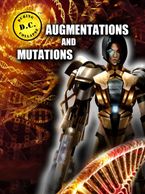
Augmentations and Mutations for D.C.: During Collapse

A.C.: After Collapse is a flexible tabletop role playing game (RPG) in a post-apocalyptic setting, published by Shadow Fusion (February, 2019).  Augmentations and Mutations is intended to be a source book for D.C.: During Collapse, A.C.: After Collapse, and B.C.: Before Collapse products.


Augmentations and Mutations was designed to give referees and players alike a comprehensive look at the super science that transformed Humanity before the collapse.  The same technology that saved billions of lives was also used by dark forces to unleash Hell on Earth.  A genetically edited world is the justification for all post-Collapse mutations that are beginning to terrorize enclave residents when game play starts.

This product provides referees with everything they need to plan a post-Collapse game experience that features your own version of "mutants."  Players are also provided with tools that can be used to make a better future, if they're up to that challenge.  The same good intentions that devastated an unprepared world might be just what you need to save the day.


Anthology, During The Colapse

A.C.: After Collapse is a tabletop role playing game (RPG) in a post-apocalyptic setting.  Published by Shadow Fusion (February 11, 2019).  During the Collapse is a collection of insightful short stories that take the reader behind the scenes during the violent years of Collapse.


Many of these astonishing events are briefly addressed throughout the source books you're able to read in the B.C.: Before Collapse, D.C.: During Collapse, and A.C.: After Collapse products.  In this anthology, you will find out about: the heroes and villains who clashed in every corner of a shattering world.  You'll be go behind the scenes as nations falls and new empires begin to form in places where Man and Machine compete for scarce resources.

Was it all for nothing?  Or, can the post-Collapse survivors still find the keys to a better future in the ruins once inhabited by their ancestors?

Anthology, Before The Collapse

A.C.: After Collapse is a tabletop role playing game (RPG) in a post-apocalyptic setting, published by Shadow Fusion (circa February 11, 2019).  Before The Collapse is a collection of short stories intended to give the read an insider's look at the best science and the worst politics that set the stage for a bloody collapse.


Many of these inspiring and heartbreaking events are briefly addressed throughout the source books you're able to read in the B.C.: Before Collapse, D.C.: During Collapse, and A.C.: After Collapse products.  In this anthology, you will find out about: the origins of the mutagenic science and weaponry that changed our future.  You'll be introduced to them men and women who made it all possible, as well as those unsung heroes and heroine who tried to prevent the decline.

Was it all for nothing?  Or, can the post-Collapse survivors still find the keys to a better future in the ruins once inhabited by their ancestors?


Small Arms Volume Two for B.C.: Before Collapse

A.C.: After Collapse is a tabletop role playing game (RPG) in a post-apocalyptic setting, published by Shadow Fusion (February 11, 2019).  Small Arms Volume II is intended to be a source book for this game system.  Small Arms Vol. II defines and describes high-tech caseless ballistic ammunition and the types of firearms that use them.


Real World Fact: "Caseless" firearms ammunition is expected to replace metal cartridge ammunition by the mid to late 21st Century.  For more specific information about cartridge guns and ammo as they appear in A.C.: After Collapse, see the source book Small Arms Volume I  .

During development and testing, a decision was made to seperate metal cartridge firearms from the more advanced caseless variants.  We recognized that some referees would prefer to play scenarios and campaigns without these more advanced weapons (i.e., to play "retro").

Unlike metal cartridge firearms, caseless guns and the powerful ammo they use must be fabricated (i.e., reproduced by computer controlled fabrication systems).  That distinction may be important to referees who like to allow crafting with some limits.  When players are allowed to create Characters who have Basic/Advanced Skills that would allow them to design and "make" (i.e., fabricate) caseless firearms, they would be able to radically change the game environment they live in.


Tuesday, July 16, 2019

Post-Apocalyptic Nostalgia

"Nostalgia," as we think of the term, is a fondness for the past.  How can you include that factor in any post-apocalyptic RPG?  A.C.: After Collapse achieves that by presenting you (i.e., the referee) with a big backstory--and--a product line of fiction based on the game (e.g., anthologies and novels).


We've done this by including a lot of background material in the Basic Rules and the source books.  All of it is sorted by category, meaning each publication addresses specific portions of pre-Collapse history (e.g., science, military science, medicine, technology, society, and economics).

Haven's Legacy is the first novel, based on the game.  You'll see more storytelling from us in 2020.  Our plan is to release two anthologies and another novel.  All three of these products are being edited now, we hope to have book covers for them by the end of 2019.

Imagine a post-Collapse world in which you decide how much or how little is known about the past.  We will provide you with a simple system to determine how much Characters and NPCs do know about the world they live in.  Some gamers like to draw on a thick rich history full of useful details, especially when that background can be used as clues to solve relevant mysteries.  Others like a more stripped down minimalist approach, they don't want to know any more about the game world than they need to complete an adventure.  Either way, A.C.: After Collapse has what you want!


Saturday, July 6, 2019

Character Profile, Tennyson

"Tennyson" is a secondary character who appears in the second half of the novel, Haven's Legacy.  He's an aging android who has a lot to say about the events that lead to the collapse of civilization.  This is the first of we are hoping will be a long line of novels based upon the post-apocalyptic RPG A.C.: After Collapse.


Tennyson was once a Federal judge--one of many forms of artificial intelligence types that were designed and built to help humans govern themselves more evenhandedly.  Lex encounters him in an underground subway terminal.  It's a fictional transportation system in Washington State that doesn't exist, though it serves an important purpose as a backdrop for the overall story.  When he sees it for himself, even Lex realizes it is a literal and metaphorical transition point for him.

Tennyson is more than a living history book, he's the gatekeeper to the one thing Lex wants most.  Much of what he says have very little meaning to Lex at the time, it's easy enough for the reader to guess that all of it will matter to him later in life.  Everything about Tennyson is proof that there are "good" AIs in the post-Collapse world that intend to help their creators.  There are also "bad guys" out there who just don't see things that way.   All of this and much more is intended by the author to makes Haven's Legacy food for thought.  Every end has a beginning, it's all up to you--can you make the future you want to live in?


Thursday, July 4, 2019

Character Profile, Lex

"Lex" is the brave teenage hero in Haven's Legacy, our first novel based on the post-apocalyptic RPG A.C.: After Collapse.  As the story unfolds, readers discover that he believes himself to be an orphan.  Lex runs for his life when a large band of bloodthirsty raiders attack the only home he's ever known, massacring everyone who dared to resist.  What starts out as a panicked effort to survive gradually becomes an epic quest to find answers to questions he never wanted to ask.


The clues are there, Lex just has to put them together--and--stay alive!  That challenge is made just a little harder by the fact that he is farsighted, he needs glasses to see people, places, and things far away before they have any chance to hurt him.  Along the way, he feels a storng need protect those who can't defend themselves.  That includes a handful of children who manage to escape the raiders and flee in to the countryside.  Surrounded by dangers he can't always see, Lex puts the pieces of his past together.  What he learns will surprise you.

His path to discovery takes him through places that have long since been forgotten, to the doorstep of a hidden treasure that will do more than give him answers.   Would you be ready to meet the family you never existed?  Could you make your peace with feelings of abandonment?  These are just a few of the challenges Lex must meet and defeat before he can be his better self.  If you are brave enough, the truth of Haven's Legacy might surprise you!


Wednesday, May 29, 2019

A.C.: After Collapse has LitRPG

Haven's Legacy is the first of what we hope will be many novels based on the post-apocalyptic RPG A.C.: After Collapse.  This novel and the Basic Rules are available from Amazon in Kindle format.  The dust-cover description reads:


 "Sixteen-year-old Lex is a strong-willed orphan who cherishes fading memories of his parents. On the verge of adulthood, he is torn between his desire to help those less fortunate and a growing need to figure out who he really is.When the post-Collapse community he lives in is attacked by marauders intent on looting the place, he must make a difficult decision: fight for what’s right or strike out on his own to find a mythical sanctuary that might not exist.Alone and on the run, he is nagged by the ghost of a dead pilot and tormented by the secrets locked away in his most prized possession. As he begins to make sense of what he finds, Lex discovers more about himself and his family than he bargained for. Can he survive the challenges that lie between him and the answers he’s looking for?"

 "Haven's Legacy" incorporates a number of the game-related concepts you can read about in the Basic Rules, as well as the story mechanics that you've come to expect from action-advanture books
set in a post-apocalyptic world.  Please look for these and other A.C. related products through you favorite online retailer.

Monday, May 27, 2019

Attributes of a Survivor

A.C.: After Collapse is a multi-faceted post-apocalyptic role-playing game (RPG) that allows you to create characters and situation to satisfy almost any style of game play.  This game and the novels based on it are intended to provide you with a roadmap to adventure.  Mechanics of the game are flexible enough to encourage newcomers while satisfying experienced referees and players with versatile genre favorites, like brutal radiation, exotic poisons, and enough combat factors to make even them feel like they did some damage.


Upper Body Strength (UBS) and Lower Body Strength (LBS) are separate attributes, ideal for players and referees who want to model a wide range of physicality (i.e., body types).  As you can see from the video (above), Agility (AGL) and Manual Dexterity (MAN) are also separated from each other. This allows players and referees some way to simulate those aspects of physicality in a way that makes sense when you're deep into role playing.

For as long as RPGs have existed as commercial products you can buy, a running debate has continued concerning the nature of character and NPC "intelligence."  Knowing that we could never hope to answer that question, we chose to present Reason (REA) as a meta-attribute that is made of Creativity (CRE) and Empathy (EMP) (i.e., CRE + EMP /2 = REA).  In the same way that characters and NPCs can be physical in so many different ways, we wanted to give gamers the same flexibility to be "smart" in many different ways.

As difficult as the question of intellect might be, there are other factors of human existence that are just as subjective.  To simplify the role-playing process, we made Willpower (WILL) just as useful for referees as it can be for players.  When players know how susceptible their characters can be to the influences of flattery and seduction, they experience a little more confidence or fear based on the situation that is unfolding.  That's why Attractiveness (ATT) confers the capacity to charm or seduce on anyone who has a high value of this attribute.

Saturday, May 18, 2019

The Written Apocalypse

Justin Oldham was interviewed by author and host Dee Cooper on The Written Apocalypse podcast, which airs on the Prepper Podcast Network (PPN).  During that one hour conversation, they talked about dystopian fiction, post-apocalyptic themes in books and movies, and, of course, our post-apocalyptic role-playing game (RPG) A.C.: After Collapse.  Topics also included some focus on our Young Adult novel Haven's Legacy.

It's a well-established fact that "gamers" are everywhere.  You can find them in every part of society.  With that in mind, we reached out to the preparedness community (i.e., "preppers") in an effort to think outside the proverbial box.  As working professionals, many people are called on every day to use role-playing tools to train new skills or resolve old conflicts.  That may seem far removed from the role-playing many of us do for entertainment,but it's not.  Using your imagination to understand what can happen, or why people think they way they do, is as productive as it is entertaining.


Friday, May 3, 2019

Preparing for Arctic Comic Con 2019

As we write this, we are finalizing preps to take A.C.: After Collapse to Arctic Comic Con (2019).  As any small business and they'll tell you how "big" this step really is.  For all intents and purposes, we are showcasing our work to people who have never seen it before.  They don't know what you already know, they haven't read any of these blog posts or watched the videos we put on YouTube.  It's all up in the air, anyone's guess how this goes.  We are hopeful.

No matter what happens, we hope you'll stop by our vendor's table.  See what we've done, talk to us.  We're just as human as anyone else, we work hard and wish for success as much as anyone else can.  If you have an idea for a book or even a game, don't give up on it.  Try hard to keep an open mind, learn what you don't know, find somebody to each the skills don't have.  Then, make and plan and move forward when each step in the process allows you to.  Yes, It will take longer than you want.  It's be a lot harder than you imagined it could be.  Chase any dream long enough or hard enough and you are bound to catch it.


Wednesday, April 24, 2019

Prepper Training Aid

A.C.: After Collapse (A.C.) is known as a post-apocalyptic role-playing game (RPG), it can also be a good family-friendly  training aid for anyone who wants to know what it might be like to live or die in a catastrophic situation (e.g., civil disorder, natural disaster, etc.).  Many of us are familiar with the basic of preparing for trouble, it's not unusual for many of us keep track of how much food and drugs we have around the house--just in case.  How many of us take the time to test decision-making skills in a fluid situation where just about anything can happen?


The short answer is, very few.  Most of us are satisfied with the supplies we have, we're even proud of ourselves for having a tool for just about any situation you can imagine.  So, what happens when your tools break--or--you run out of something that you just can't get...anymore?  Sounds farfetched?  No, not really.  That's the kind of thing role players have been coping with for almost half a century.  many of them do it with imaginary swords and magic, we are suggesting that you might want to do something like this with the supplies and equipment you can relate to.


A.C.: After Collapse features a very wide range of food, drugs, equipment, firearms, and body armor that you might already be familiar with.  280-pages of easy to follow game mechanics allow you to simulate everything from climate and combat to the more unpleasant consequences of nuclear war, climate change, or the occasional government coupe.  All this is laid out in family-friendly language suitable for ages 14+.  Want to know more?  Basic Equipment Guide introduces you to a variety of simulated tools, building materials, and durability factors (i.e., combat conditions).


For those of you who want to use the nuts and bolts of tabletop gaming to simulate the effects of combat, we recommend the Food and Drugs supplement before you go looking for guns 'n ammo.  The Small Arms Guide introduces you to simulated firearms effects and how they work in attack or defensive roles (i.e., situations).   As much fun as all that may be, you might want to dig deep in to our simulated Personal Protection Equipment (PPE) for a better comparison of anti-ballistic helmets, vests, and things far more advanced.  None of pretend-prep would be complete without a thorough technology architecture that will allow you to simulate everything from cell phones to kill-bots.  Gadgets, Devices, and Computers will let you do just that.

With all of this in mind, it's not hard to see how you might like to have a family-friendly training aid like A.C.: After Collapse--on your bookshelf or in your bunker!


Tuesday, April 16, 2019

Before, During, and After


A.C.: After Collapse is a post-apocalyptic RPG with a big back story that has been divided in to three parts: Before, During, and After.  Creator Justin Oldham explains why:


"Once upon a time, I was a student of history.  I mean that literally, I was academically pursuing a bachelor’s degree in the subject of history.  As I read about the decline and fall of civilizations and empires, I couldn’t help thinking about those chronologies in three parts.  Before, during, and after somehow made sense to me.  When I did my homework as it was assigned, I found myself writing essays with prefaced remarks that began with: before collapse, during collapse, and after collapse.  There’s really nothing remarkable about that, it’s just how my mind worked."


"As the years passed, I filled an entire notebook with names, dates, people, places, and things that populated the increasing fragments my fictional history of the future world that was eventually going to end.  Using one game system after another as they appeared on the shelves of local stores, we played characters who lived and searched in just about every corner of the world.  The more my fellow gamers wanted to plumb the depths of the world their characters lived in, the more I needed to know about what happened before that fictional world fell apart."

"It’s all fine and well to present post-apocalyptic gamers with the ruins of buildings and bunkers—but—you as the game presenter need to have some sense of what happened in those places before any of the player characters ever set foot in those places.  Think of it as theater of the mind.  What kind of slow moving catastrophe caused an office building to be empty?  If you do describe dust-covered telephones, computers, and the “stuff” people find in cubicles, it’s a good idea to know how those things got there—or—why they were left behind.  Imagine what gruesome remains might be found in a bunker that was quickly sealed—before anyone had a chance to get out!"

"Then, ask yourself what kind of emergency would happen in a place like that, to permanently enshrine that much carnage?  Might be fun to describe desiccated corpses in the armory, or any number of dead guys in a sealed room marked “laboratory,” but you’ve still got to know why they are there.  All of that, even the grisly imagery, made me think in big-picture terms when I planned the backstory of the dynamic world that is now A.C.: After Collapse."

Tuesday, April 9, 2019

From the Mail Bag

We recently got several questions by e-mail about the nature of the Collapse, as it was presented in A.C.: After Collapse.  Creator Justin Oldham provides the following commentary:


"I grew up during the Cold War.  NATO vs. Warsaw Pact (i.e., USA vs. USSR) was all the rage in books, movies, and television.  At the time, the most common 'theme' was quite often nuclear war.  As much as it was hyped, I still couldn't stop thinking about the other potentials we'd eventually face, especially as the 21st Century got closer.  For most of us born in the mid-point of the 20th Century, the future was all about teh 21st Century.  We had high hopes for it, even though we were still busy with the whole Soviet Union thing."

"As we lived through the 1990's, many things became a little more apparent.  They included the rise of stateless terrorism and the perils of artificial intelligence.  You can add what we now call Climate Change to that roster of risks.  As we laid out the game's architecture, it became clear to most of us that referees could have their choice of a Collapse that began for many reasons.  That's where we got the phrase, a Collapse of many causes."


Saturday, April 6, 2019

Importance of Background Knowledge

A.C.: After Collapse is a post-apocalyptic RPG that uses a "classless" character generation system.  Players are provided with flexible easy to read rules that allow them to imagine any combination of knowledge and skills  they want.  Attributes for characters include mental and physical meta-scores that give players and referees more options when role playing or in combat.


Age is a determining factor for many elements when players create their post-Collapse characters.  Younger people are presumed to know less than their adult counterparts.  Individuals are allowed to have one category of Background Knowledge (BKN) for every three years of age they are at the time the character is created (Age/3 = # of BKN).  Players are encouraged to think of BKN as the context that their character has for what they see and hear as the game progresses.  Referees can use BKN categories as a form of measuring stick, to determine what is or is not common knowledge for the average post-Collapse person.


Some of the most common categories of Background Knowledge include: Agrarian Lore, Aviation Lore, Collapse Lore, Consumer Lore, Low-Tech Weapon Lore, Machine Lore, Military Lore , NBC Lore, Small Arms Lore, Transportation Lore, and Watercraft Lore.   Plese have a look at the Basic Rules for a more detailed list.  Referees who sometimes struggle with what characters do or don't know in certain situations will find the system of Background Knowledge to be useful.   Players are encouraged to think of them as a form of context.  During casual play, this makes it easier for everyone to "act" on the basis of what they do actually know. 

Saturday, March 30, 2019

A Collapse of Many Causes

A.C.: After Collapse is a post-apocalyptic role-playing game, its development was inspired by many real-world factors that included a long list of similar RPGs.  Woven in to this fabric of this fictional future is a high-tech international news media that calls the slow decline they so vigorously report on "a collapse of many causes."  We began this project with the intention of providing participants with the tools they'd need to play before, during, and after the Collapse.


As much fun as post-Collapse play can be, there are always going to be some gamers who want to know, "What in the Hell happened?"  How did things get this way?  Why in the world was anyone stupid enough to just let this happen?  Those are good questions and they do deserve to be answered.  Throughout human history, chroniclers of all sorts have in some way documented the decline and fall of the empires or civilizations they lived in.  We wanted to use every tool at our disposal to bring you that option, as a form of game play.

Justin Oldham, creator of A.C. recalls: "No matter what game system we used, somebody always wanted to know more about the pre-apocalyptic world.  That inevitably lead to many game sessions in which we--the players--went looking for clues in some very dark, deep, and inhospitable places.  Searching for libraries, government bunkers, and such turned out to be an immense challenge for the referees who had the job of presenting that game to us.  That can sound simple enough, but it's not.  When you are an armchair historian and books are some of your best friends, you can do this without feeling overwhelmed.  The chore can seem much too big, when you're just not in to doing all of the research that ends up on the game table.  When it was my turn to run games, I may have gone just a bit overboard with my preparations.  I had simulated maps and pre-Collapse documents of all sorts, always ready when the next player wanted to go digging."

Everything from terrorism and climate change, to rogue AI and regional wars have played some part in the backstory presented in A.C.: After Collapse.  You can use some of it, all of it, or none of it--as you see fit.  No matter what mysteries your players prefer to solve, there's always going to be some "thing" for everyone to enjoy in this dynamic world.

Classless Character Creation

A.C.: After Collapse was designed with a classless character creation system in mind from the start.  Role-playing games have come a long way since the 1970's.  Many of them have been translated to the online environment, where they flourish today.  Ask any game designer, and they'll tell you, there are pros and cons to any system of classes that a game architecture might use.


Justin Oldham is the creator of A.C., he borrowed from more than three decades of experience with RPGs of all sorts.  "As a player of these games, I couldn't help noticing that the way characters are built does determine how they are 'played' -- used by the flesh-and-blood people who are players.  When there is no attribute for something, they can't easily do it.  When there is no rule for something, they don't always try to do...whatever it is.  We were never going to nail down every rule for everything that could happen during game play--but--we could provide participants with attributes that encouraged them to 'do' a very wide range of things."


Age is a determining factor for many elements when players create their post-Collapse characters.  Younger people are presumed to know less than their adult counterparts.  Individuals are allowed to have one category of Background Knowledge (BKN) for every three years of age they are at the time the character is created (Age/3 = # of BKN).  Players are encouraged to think of BKN as the context that their character has for what they see and hear as the game progresses.  Referees can use BKN categories as a form of measuring stick, to determine what is or is not common knowledge for the average post-Collapse person.

The game includes seven physical attributes.  They are: Upper Body Strength, Lower Body Strength, Manual Dexterity, Agility, Attractiveness, Hardiness, and Vigor.  There are two mental attributes -- Willpower and Reason.  The age of a fictional person determines how many d6 are rolled for these attributes, when characters are created.  The published rule is 1d6 for every 5 years of age that a character is when game play starts.  A human maximum of 30 is recommended for all stats.  A 30-year old character could have attributes of 25-30, based on the results of 5d6 as rolled.

Players have the freedom to pick and choose from Basic Skill groups that contain three subfields when they are creating a character.  Each area of interest can be thought of as a broad representation of the knowhow that it would take to perform those tasks.  Some areas of interest have prerequisites to simulate the fact that additional knowledge must be acquired before it's possible to perform that complex task or make use of what could be sophisticated (i.e., academic) facts and figures.  Any character can have any skill for which they meet the prerequisites.

Players can acquire Character Points (CPs) during the course of a game session.  These can be used in a variety of ways.  A player can "purchase" the option if bettering their character's chances of performing particular act, learn or increase their knowledge of a particular skill, or raise the value of a particular attribute.

Referees have the option of developing scenarios designed to be played in a limited number of game sessions or campaigns that are intended to be played over a longer period of time.  Either way, character points can be earned when the players have their characters solve challenges, perform acts that are particularly useful in reaching a goal, or make other decisions that somehow further the story.  It's recommended that a character receive between 1 and 5 character points in a session.  This prevents the game from being unbalanced because characters are too "lucky" or improve too quickly.

As time passes in the game and characters gets older, it is possible for them to be affected by the aging process.  This is reflected through a reduction in certain attributes that begins when they reach age 30 and continue each year of game time.  These attribute reductions can be offset by using earned CPs to increase or retain the values.  This represents the character performing activities designed to retain their youthful physical and mental prowess, as happens with modern people who go to the gym or perform mental tasks that are intended to help them keep their physical strength, mobility, and mental faculties.